3 women, 1 non-binary person, building a more inclusive community
When disability has nothing but everything to do with success
As part of celebrating UN’s International Women’s Day we profiled 4 people from our own patch, whose disability has nothing but everything to do with their success. When we live in a world that is not designed for us, the need to be resilient, resourceful and innovative becomes a necessity.
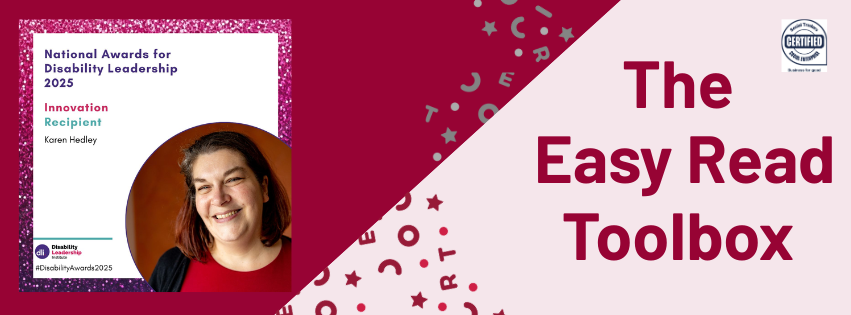
Karen Hedley – Founder, Easy Read Toolbox
Innovation making Easy Read easy
Karen founded the Easy Read Toolbox in 2021 – the idea came from her previous social enterprise Next level inclusion. ‘I launched my first social enterprise, Next Level Inclusion in 2021, a communication and accessibility service for disability service providers. The demand was so great and I quickly realised that I couldn’t help as many people as I wanted to, so the idea of The Easy Read Toolbox was born,’ says Karen.
Karen is the recipient of the 2015 ACT Chief Minister's Inclusion Award for Lifetime Achievement in Support Work, the 2026 Disability Leadership Innovation award and is 2025-26 SECNA Women in Social Enterprise Champion. This is no surprise as she runs a workplace with highly productive and skilled individuals and a very low staff turnover, a sign of the very successful and inclusive workplace model she’s set up.
Karen was diagnosed with ADHD in 2014 an after earlier diagnosis with multiple disabling autoimmune conditions. She suffers fatigue, pain and memory problems which are just but a few of the symptoms. ‘These were unexpected (I thought it would just be pain!). Trying to set up and oversee a business has been challenging. I still struggle with networking, as most is in the evening, when my conditions mean I'm unable to attend’ says Karen.
Karen has 30 years of experience in the disability sector and started taking an interest in easy-to-read communication around 12 years ago when it first arrived in Australia.
Having her 3 children diagnosed with autism and acquiring her own disabilities added to her passion to make our community more inclusive and accessible for people with disabilities. Even though Karen identified as a person with disability she did not really ‘use’ it, until the Easy Read Toolbox began promoting lived experience, as the team’s biggest strength.
To be able to function despite her disabilities and her role as a carer for three neurodivergent young people, Karen set up the business in a way that suits her needs and allows all team members the same courtesy. Also, she’s worked hard with the team's support to put things in place to make work easier for her, such as using apps and physical reminders to jog memory, having other team members attend events either with or in her place, as well as building in flexible hours.
‘Running a social enterprise has made for some satisfying moments’ says Karen. For a number of Karen’s team, this is their first employment opportunity. “Several of our younger contractors have said we were the first to give them a chance at working. Knowing we are paying them fairly is amazing too,” she said.
The Easy Read Toolbox is a certified Social Enterprise and has completed projects for medium and large organisations such as banks, educational institutions and government agencies.
You can read more about the Easy Read Toolbox here.
Sonya Kunawicz - Training and Development, Disability Equality Scotland
Easy Read beyond borders
Sonya is a Training and Development Worker with Disability Equality Scotland. Her job includes developing and delivering training and support to Easy Read writers. Sonya’s background is in education, language, and editing.
Sonya is neurodivergent. Lived and learned experience drive everything she does in her work. ‘I have a strong interest in communication, inclusion, and accessibility. I finally have a job that makes sense to me!’ Sonya says.
Since September 2024, Sonya has, with Disability Equality Scotland, been researching and testing a set of minimum standards for Easy Read, making sure everything is people-centred and adaptable for different communication needs. Sonya was instrumental in establishing a long-term project in the UK, to develop and test national standards for Easy Read. She explains that, across the UK (and beyond) the quality of published Easy Read is quite variable. Most Easy Read is excellent - written by experienced professionals who work closely with users. But some Easy Read does not communicate clearly.
‘We are working with disabled people and researchers to make sure our standards work in reality. The first public version of our standards will be published in October 2026, supported by public bodies, disabled people's organisations, and (most importantly) by Easy Read users across the UK’, says Sonya.
One of Sonya’s greatest achievements was the establishment of the International Easy Read Community of Practice (CoP) two years ago. Sonya worked with Karen Hedley to set up the CoP which meets monthly. Easy Read writers often work in small teams, or in isolation. ‘It’s been very exciting to get such a big group together to share ideas about how we work. It's hard to find a meeting time that works for everyone, because we work across such different time zones, but somehow, we manage,’ says Sonya.
Across the English speaking world, accessible communication professionals like Sonya are working to promote Easy Read to ensure that everyone has access to the information they need.
You can find out more about the International Community of Practice here.
Debbie McKenna – Business owner, Adapt Virtual Assistance
Filling gaps and creating opportunities
Debbie built a thriving virtual assistant business, Adapt Virtual Assistance with little to no experience. Since then, she’s trained other people with disability to also become virtual assistants, creating custom-fit careers built to their needs.
Debbie has a rare condition called Oculo-facio-cardio-dental syndrome (what a name!). She’s had multiple surgeries on her eyes, heart and face, but Debbie says, “the biggest difference I navigate each day is being vision impaired.”
Debbie’s vision impairment impacts both her working and personal life. She’s restricted in screen time, which results in not always being able to grow and shape her business at the rate she would like to. It also means that if she’s had a particularly long screen day, the rest of the week will be impacted too. “It's a lot to manage mentally, doing the math gymnastics on if I work to finish X thing, then I may have to sacrifice doing Y thing tomorrow,” says Debbie.
Her vision impairment impacts her personal life in various ways, such as not being able to drive, and household chores can be a drain on her eyes and energy levels. “Like many of us, I adapted through school and even earned a degree in visual communication. The irony still makes me smile,” Debbie quips. However, living in a world that was not set up for people with disability, all the effort in the world did not make graphic design roles accessible at the time, and in Debbie’s words “my degree collected dust for years.”
Like a lot of determined people, Debbie was resistant to support growing up, but she’s learnt to accept it whenever and wherever she can these days. In spite, or despite her struggles, she’s succeeded in building a solid career and business that also helps people with disability build their own career and business.
“I think there is a lot of value in community. Community of those around you who understand and are willing to help you out, and a community of those who face similar challenges and can relate to those little struggles we often face each day!” says Debbie.
As Debbie very eloquently puts it, and will resonate with a lot of us, “It's important to me both personally and professionally, to prove to myself and encourage others that your disability doesn't have to define your career choices. We should all have the flexibility to work in industries and career paths that bring us joy, challenge us, motivate us and encourage us to see what's possible. I took an un-used degree, a passion for social media and a drive to work with disabled founders and created a career I adore, that also gives me the flexibility to meet my disability needs.”
You can learn more about Debbie’s work here
Megan Munro – artist, performer and producer
Art as activism, advocacy and healing
Megan is a queer, disabled artist, activist, performer and producer, having worked a ‘day job’ for 25 years, in various education, advocacy and policy roles in the Canberra Community sector. Megan is the founder of the Queer Variety Show, which is for SGLGBTIQA+/queer and disabled people and allies.
Megan has ME/CFS or Myalgic Encephalomyelitis or Chronic Fatigue Syndrome, Fibromyalgia and was diagnosed with autism only 15 months ago at the age of 56. ‘’The ME/CFS is the most debilitating of the three conditions’’, explains Megan, ‘’It really means I’m limited with my energy. Most people have no idea what it’s like and there’s a lot of misinformation out there. It often gets shortened to Chronic Fatigue, but chronic fatigue is only just a symptom of many different illnesses’
Megan has been sick for about 15 years with symptoms of ME/CFS starting out as mild then, getting worse over a period of time. ‘’I hit a wall in 2018 with it and had to stop work and nearly everything I was doing entirely. I could hardly move and I hardly left my house. My world became very small. I felt very socially isolated, as I couldn’t get most of the people around me to really understand how limited I was’’, Megan says.
People with ME cannot ‘push through’ or the condition can become permanently worse. In the last few years Megan was also diagnosed with Fibromyalgia, which is close to ME/CFS, but it tends to include more painful symptoms. Megan says ‘’It’s relatively new to me, so I don’t really understand what triggers it yet’’.
The two conditions combined can make life very unpredictable. For example, exercise is believed to help with Fibromyalgia symptoms but because of ME, Megan is limited to what type of exercise they engage in as it can be dangerous, unless it is very gentle. ‘’It’s a constant balancing act. I got a bit better over the last 8 years through pacing, using a heart monitor and a very slow return to some physical activity. I’m still unable to go out very much and I have to constantly watch my energy,” Megan tells us.
But being diagnosed with autism has been liberating, although a lot to process. That’s 56 years of events and trauma. Megan says, ‘’I have days where I am filled with anger at everything. The way I have been bullied in the past, the way people have taken advantage of me and the way I’ve had problems connecting to people and loss of friends. However, I try to tell myself that I did very well at looking after myself through years of the world having little knowledge of what autism really is. Not masking now means that I can access the better and more interesting parts of who I really am and this is very exciting when it comes to my creative expression’’.
Upon not being able to work, Megan returned to making visual art. Megan has been a performer for many years now and continues to be when energy levels and symptoms allow. ‘’I am very proud of the way I have used my art and performance to enrich my life. We produce a bi monthly variety show that platforms queer and disabled performers. I proudly identify as queer and disabled and these identities are the focus of all my creative endeavours’’.
You can follow Megan’s art at @meganmunro1968, @sparklemuffin_Mena.Paws, @Queer_Variety_Show and learn more at https://www.arachneart.com.au. Megan was also a finalist in the 2025 Creative Challenge Finalists Exhibition Online, check it out at https://craftanddesigncanberra.org